World's most popular travel blog for travel bloggers.

 Data Types in Java

Data types specify the different sizes and values that can be stored in the variable. There are two types of data types in Java:

  1. Primitive data types: The primitive data types include boolean, char, byte, short, int, long, float and double.

  2. Non-primitive data types: The non-primitive data types include Classes, Interfaces, and Arrays.

Java Primitive Data Types

There are 8 types of primitive data types:

  • boolean data type

  • byte data type

  • char data type

  • short data type

  • int data type

  • long data type

  • float data type

  • double data type

Java Data Types

Data Type

Default Value

Default size

boolean

false

1 bit

char

'\u0000'

2 byte

byte

0

1 byte

short

0

2 byte

int

0

4 byte

long

0L

8 byte

float

0.0f

4 byte

double

0.0d

8 byte

Boolean Data Type

The Boolean data type is used to store only two possible values: true and false. This data type is used for simple flags that track true/false conditions.

The Boolean data type specifies one bit of information, but its "size" can't be defined precisely.

Example: Boolean one = false

Byte Data Type

The byte data type is an example of primitive data type. It isan 8-bit signed two's complement integer. Its value-range lies between -128 to 127 (inclusive). Its minimum value is -128 and maximum value is 127. Its default value is 0.

The byte data type is used to save memory in large arrays where the memory savings is most required. It saves space because a byte is 4 times smaller than an integer. It can also be used in place of "int" data type.

Example: byte a = 10, byte b = -20

Short Data Type

The short data type is a 16-bit signed two's complement integer. Its value-range lies between -32,768 to 32,767 (inclusive). Its minimum value is -32,768 and maximum value is 32,767. Its default value is 0.

The short data type can also be used to save memory just like byte data type. A short data type is 2 times smaller than an integer.

Example: short s = 10000, short r = -5000

Int Data Type

The int data type is a 32-bit signed two's complement integer. Its value-range lies between - 2,147,483,648 (-2^31) to 2,147,483,647 (2^31 -1) (inclusive). Its minimum value is - 2,147,483,648and maximum value is 2,147,483,647. Its default value is 0.

The int data type is generally used as a default data type for integral values unless if there is no problem about memory.

Example: int a = 100000, int b = -200000

Long Data Type

The long data type is a 64-bit two's complement integer. Its value-range lies between -9,223,372,036,854,775,808(-2^63) to 9,223,372,036,854,775,807(2^63 -1)(inclusive). Its minimum value is - 9,223,372,036,854,775,808and maximum value is 9,223,372,036,854,775,807. Its default value is 0. The long data type is used when you need a range of values more than those provided by int.

Example: long a = 100000L, long b = -200000L

Float Data Type

The float data type is a single-precision 32-bit IEEE 754 floating point.Its value range is unlimited. It is recommended to use a float (instead of double) if you need to save memory in large arrays of floating point numbers. The float data type should never be used for precise values, such as currency. Its default value is 0.0F.

Example: float f1 = 234.5f

Double Data Type

The double data type is a double-precision 64-bit IEEE 754 floating point. Its value range is unlimited. The double data type is generally used for decimal values just like float. The double data type also should never be used for precise values, such as currency. Its default value is 0.0d.

Example: double d1 = 12.3

Char Data Type

The char data type is a single 16-bit Unicode character. Its value-range lies between '\u0000' (or 0) to '\uffff' (or 65,535 inclusive).The char data type is used to store characters.

Example: char letterA = 'A


Switched communications network

A switched communications network transfers data from source to destination through a series of network nodes. Switching can be done in one of two ways. In a circuit-switched network, a dedicated physical path is established through the network and is held for as long as communication is necessary. An example of this type of network is the traditional (analog) telecom system. A packet switched-network, on the other hand, routes digital data in small pieces called packets, each of which proceeds independently through the network. In a process called store-and-forward, each packet is temporarily stored at each intermediate node, then forwarded when the next link becomes available. In a connection-oriented transmission scheme, each packet takes the same route through the network, and thus all packets usually arrive at the destination in the order in which they were sent. Conversely, each packet may take a different path through the network in a connectionless or datagram scheme. Since datagrams may not arrive at the destination in the order in which they were sent, they are numbered so that they can be properly reassembled. The latter is the method that is used for transmitting data through the Internet.

 Electromagnetic Spectrum consists of entire range of electromagnetic radiation. Radiation is the energy that travels and spreads out as it propagates. The types of electromagnetic radiation that makes the electromagnetic spectrum.

  • Supports larger bandwidth and hence more information is transmitted. For this reason, microwaves are used for point-to-point communications.
  • More antenna gain is possible.
  • Higher data rates are transmitted as the bandwidth is more.
  • Antenna size gets reduced, as the frequencies are higher.
  • Low power consumption as the signals are of higher frequencies.
  • Effect of fading gets reduced by using line of sight propagation.
  • Provides effective reflection area in the radar systems.
  • Satellite and terrestrial communications with high capacities are possible.
  • Low-cost miniature microwave components can be developed.
  • Effective spectrum usage with wide variety of applications in all available frequency ranges of operation.

Properties of Microwaves

Following are the main properties of Microwaves.

  • Microwaves are the waves that radiate electromagnetic energy with shorter wavelength.
  • Microwaves are not reflected by Ionosphere.
  • Microwaves travel in a straight line and are reflected by the conducting surfaces.
  • Microwaves are easily attenuated within shorter distances.
  • Microwave currents can flow through a thin layer of a cable.

 Object-oriented programming (OOP) is a computer programming model that organizes software design around data, or, rather than functions and logic. An object can be defined as a data field that has unique attributes and behavior.

The organization of an object-oriented program also makes the method beneficial to collaborative development, where projects are divided into groups.

Principles of OOP

Object-oriented programming is based on the following principles:

  • Encapsulation. The implementation and state of each object are privately held inside a defined boundary, or class. Other objects do not have access to this class or the authority to make changes but are only able to call a list of public functions, or methods. This characteristic of data hiding  provides greater program security and avoids unintended data corruption
  • Abstraction: Objects only reveal internal mechanisms that are relevant for the use of other objects, hiding any unnecessary implementation code. This concept helps developers more easily make changes and additions over time.
  • Inheritance: Relationships and subclasses between objects can be assigned, allowing developers to reuse a common logic while still maintaining a unique hierarchy. This property of OOP forces a more thorough data analysis, reduces development time and ensures a higher level of accuracy.
  • Polymorphism: Objects can take on more than one form depending on the context. The program will determine which meaning or usage is necessary for each execution of that object, cutting down the need to duplicate code.

Organizations produce and gather data as they operate. Contained in a database, data is typically organized to model relevant aspects of reality in a way that supports processes requiring this information. Knowing how this can be managed effectively is vital to any organization.

What is a Database Management System (or DBMS)?


Organizations employ Database Management Systems (or DBMS) to help them effectively manage their data and derive relevant information out of it. A DBMS is a technology tool that directly supports data management. It is a package designed to define, manipulate, and manage data in a database.

Some general functions of a DBMS:

  • Designed to allow the definition, creation, querying, update, and administration of databases
  • Define rules to validate the data and relieve users of framing programs for data maintenance
  • Convert an existing database, or archive a large and growing one
  • Run business applications, which perform the tasks of managing business processes, interacting with end-users and other applications, to capture and analyze data

Some well-known DBMSs are Microsoft SQL Server, Microsoft Access, Oracle, SAP, and others.

Components of DBMS

DBMS have several components, each performing very significant tasks in the database management system environment. Below is a list of components within the database and its environment.


Software
This is the set of programs used to control and manage the overall database. This includes the DBMS software itself, the Operating System, the network software being used to share the data among users, and the application programs used to access data in the DBMS.


Hardware
Consists of a set of physical electronic devices such as computers, I/O devices, storage devices, etc., this provides the interface between computers and the real world systems.


Data
DBMS exists to collect, store, process and access data, the most important component. The database contains both the actual or operational data and the metadata.


Procedures
These are the instructions and rules that assist on how to use the DBMS, and in designing and running the database, using documented procedures, to guide the users that operate and manage it.


Database Access Language
This is used to access the data to and from the database, to enter new data, update existing data, or retrieve required data from databases. The user writes a set of appropriate commands in a database access language, submits these to the DBMS, which then processes the data and generates and displays a set of results into a user readable form.


Query Processor
This transforms the user queries into a series of low level instructions. This reads the online user’s query and translates it into an efficient series of operations in a form capable of being sent to the run time data manager for execution.


Run Time Database Manager
Sometimes referred to as the database control system, this is the central software component of the DBMS that interfaces with user-submitted application programs and queries, and handles database access at run time. Its function is to convert operations in user’s queries. It provides control to maintain the consistency, integrity and security of the data.


Data Manager
Also called the cache manger, this is responsible for handling of data in the database, providing a recovery to the system that allows it to recover the data after a failure.


Database Engine
The core service for storing, processing, and securing data, this provides controlled access and rapid transaction processing to address the requirements of the most demanding data consuming applications. It is often used to create relational databases for online transaction processing or online analytical processing data.


Data Dictionary
This is a reserved space within a database used to store information about the database itself. A data dictionary is a set of read-only table and views, containing the different information about the data used in the enterprise to ensure that database representation of the data follow one standard as defined in the dictionary.


Report Writer
Also referred to as the report generator, it is a program that extracts information from one or more files and presents the information in a specified format. Most report writers allow the user to select records that meet certain conditions and to display selected fields in rows and columns, or also format the data into different charts.

When multiple trisection execute concurrently in an uncontrolled or unrestricted manner, then it might lead to several problems. These problems are commonly referred to as concurrency problems in database environment. The five concurrency problems that can occur in database are:

(i). Temporary Update Problem
(ii). Incorrect Summary Problem
(iii). Lost Update Problem
(iv). Unrepeatable Read Problem
(v). Phantom Read Problem 

These are explained as following below.

  1. Temporary Update Problem:
    Temporary update or dirty read problem occurs when one transaction updates an item and fails. But the updated item is used by another transaction before the item is changed or reverted back to its last value.

    Example:

    In the above example, if transaction 1 fails for some reason then X will revert back to its previous value. But transaction 2 has already read the incorrect value of X.


  2. Incorrect Summary Problem:
    Consider a situation, where one transaction is applying the aggregate function on some records while another transaction is updating these records. The aggregate function may calculate some values before the values have been updated and others after they are updated.

    Example:

    In the above example, transaction 2 is calculating the sum of some records while transaction 1 is updating them. Therefore the aggregate function may calculate some values before they have been updated and others after they have been updated.

  3. Lost Update Problem:
    In the lost update problem, update done to a data item by a transaction is lost as it is overwritten by the update done by another transaction.

    Example:

    In the above example, transaction 1 changes the value of X but it gets overwritten by the update done by transaction 2 on X. Therefore, the update done by transaction 1 is lost.

  4. Unrepeatable Read Problem:
    The unrepeatable problem occurs when two or more read operations of the same transaction read different values of the same variable.

    Example:

    In the above example, once transaction 2 reads the variable X, a write operation in transaction 1 changes the value of the variable X. Thus, when another read operation is performed by transaction 2, it reads the new value of X which was updated by transaction 1.

  5. Phantom Read Problem:
    The phantom read problem occurs when a transaction reads a variable once but when it tries to read that same variable again, an error occurs saying that the variable does not exist.

    Example:

    In the above example, once transaction 2 reads the variable X, transaction 1 deletes the variable X without transaction 1’s knowledge. Thus, when transaction 2 tries to read X, it is not able to it.

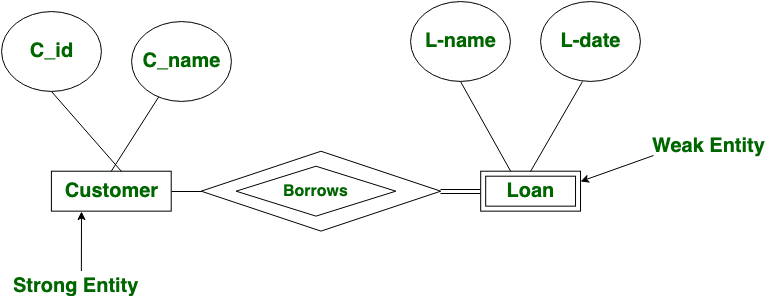
 A strong entity is not dependent of any other entity in the schema. A strong entity will always have a primary key. are represented by a single rectangle. The relationship of two strong entities is represented by a single diamond.

Various strong entities, when combined together, create a strong entity set.


A weak entity is dependent on a strong entity to ensure the its existence. Unlike a strong entity, a weak entity does not have any primary key. It instead has a partial discriminator key. A weak entity is represented by a double rectangle.
The relation between one strong and one weak entity is represented by a double diamond.


Difference between Strong and Weak Entity:

S.NOStrong EntityWeak Entity
1.Strong entity always has primary key.While weak entity has partial discriminator key.
2.Strong entity is not dependent of any other entity.Weak entity is depend on strong entity.
3.Strong entity is represented by single rectangle.Weak entity is represented by double rectangle.
4.Two strong entity’s relationship is represented by single diamond.While the relation between one strong and one weak entity is represented by double diamond.
5.Strong entity have either total participation or not.While weak entity always has total participation.

 Data Replication is the process of storing data in more than one site or node. It is useful in improving the availability of data. It is simply copying data from a database from one server to another server so that all the users can share the same data without any inconsistency. The result is a distributed database in which users can access data relevant to their tasks without interfering with the work of others.

Data replication encompasses duplication of transactions on an ongoing basis, so that the replicate is in a consistently updated state and synchronized with the source.However in data replication data is available at different locations, but a particular relation has to reside at only one location.

There can be full replication, in which the whole database is stored at every site. There can also be partial replication, in which some frequently used fragment of the database are replicated and others are not replicated.

Types of Data Replication –

  1. Transactional Replication – In Transactional replication users receive full initial copies of the database and then receive updates as data changes. Data is copied in real time from the publisher to the receiving database(subscriber) in the same order as they occur with the publisher therefore in this type of replication, transactional consistency is guaranteed. Transactional replication is typically used in server-to-server environments. It does not simply copy the data changes, but rather consistently and accurately replicates each change.
  2. Snapshot Replication – Snapshot replication distributes data exactly as it appears at a specific moment in time does not monitor for updates to the data. The entire snapshot is generated and sent to Users. Snapshot replication is generally used when data changes are infrequent. It is bit slower than transactional because on each attempt it moves multiple records from one end to the other end. Snapshot replication is a good way to perform initial synchronization between the publisher and the subscriber.
  3. Merge Replication – Data from two or more databases is combined into a single database. Merge replication is the most complex type of replication because it allows both publisher and subscriber to independently make changes to the database. Merge replication is typically used in server-to-client environments. It allows changes to be sent from one publisher to multiple subscribers.

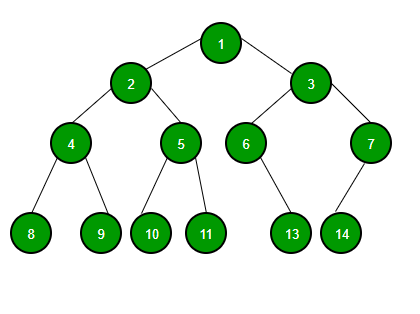
 A tree whose elements have at most 2 children is called a binary tree. Since each element in a binary tree can have only 2 children, we typically name them the left and right child.

A Binary Tree node contains following parts.

  1. Data
  2. Pointer to left child
  3. Pointer to right child


AVL Tree-

  • AVL trees are special kind of binary search trees.
  • In AVL trees, height of left subtree and right subtree of every node differs by at most one.
  • AVL trees are also called as self-balancing binary search trees.

Example-

Following tree is an example of AVL tree-

This tree is an AVL tree because-

  • It is a binary search tree.
  • The difference between height of left subtree and right subtree of every node is at most one.

Following tree is not an example of AVL Tree-

AVL Tree Operations-

Like BST Operation commonly performed operations on AVL tree are-

  1. Search Operation
  2. Insertion Operation
  3. Deletion Operation

Case-01:

  • After the operation, the balance factor of each node is either 0 or 1 or -1.
  • In this case, the AVL tree is considered to be balanced.
  • The operation is concluded.

Case-02:

  • After the operation, the balance factor of at least one node is not 0 or 1 or -1.
  • In this case, the AVL tree is considered to be imbalanced.
  • Rotations are then performed to balance the tree.

AVL Tree Rotations-

Kinds of Rotations-

There are 4 kinds of rotations possible in AVL Trees-

  1. Left Rotation (LL Rotation)
  2. Right Rotation (RR Rotation)
  3. Left-Right Rotation (LR Rotation)
  4. Right-Left Rotation (RL Rotation)

Cases Of Imbalance And Their Balancing Using Rotation Operations-

Case-01:

Case-02:

Case-03:

Case-04: